
Relocation notice
The Crime Laboratory is moving to 135 N. Chestnut Street
The Missouri State Highway Patrol Crime Laboratory, currently located at 1510 East Elm Street, Jefferson City, Missouri, will be relocating to a new facility at 135 N. Chestnut Street, Jefferson City, Missouri, on or about January 1, 2027. Please update your records to reflect the new Crime Laboratory address:
Missouri State Highway Patrol
Crime Laboratory
135 N. Chestnut Street
Jefferson City, MO 65101
Additional information regarding the transition, including any changes to evidence submission procedures or services, can be obtained by contacting the laboratory at (573) 526-6134.
The new building is the State of Missouri Multi-Agency Laboratory Campus, which will also house laboratories for the Departments of Health and Senior Services, Natural Resources, Agriculture, and Conservation. Read about the project (opens on oa.mo.gov).
The Study of Small Object Transfer
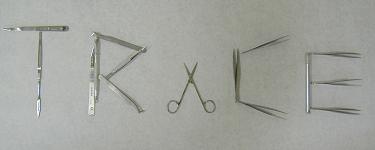
Whenever two objects come into contact there is always a transfer of material. The methods of detection may not be sensitive enough to demonstrate this, or the decay rate may be so rapid that all evidence of transfer has vanished after a given time. Nonetheless, the transfer has taken place.
Edmond Locard
Trace Evidence can be divided into two types of analyses.
Substance Comparison
The class characteristics of a sample are compared against a known source to determine whether the sample can be associated with a person or object. Examples include hairs, fibers, paint, soil, tape, and glass.
Sample Identification
Samples are analyzed to determine whether a particular substance is present. Examples include fire debris analysis, explosives, gunshot residue, and substance identification.
Areas of Examination
Explosives
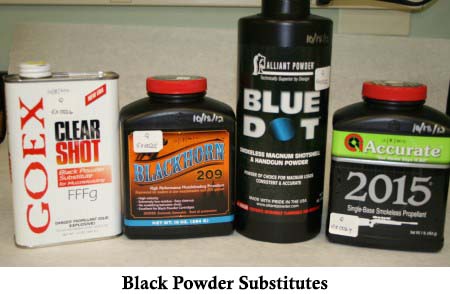
Explosives cases arise when suspected or illegal explosive devices are confiscated, or when an explosion takes place damaging property or injuring people. Typical types of explosives analyzed include black powder, black powder substitutes, single and double base smokeless powders, and pyrotechnics.
Because of the range of explosives that may be encountered, a variety of analytical tests are used by the explosives examiner. Common tests include microcrystal tests with microscopy, Fourier transform infrared spectrometry (FTIR), scanning electron microscopy with energy dispersive spectrometry (SEM/EDS), and gas chromatography/mass spectrometry (GC/MS).
Content updated 11 August 2020.
Fibers
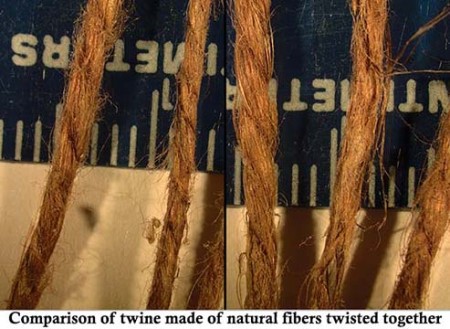
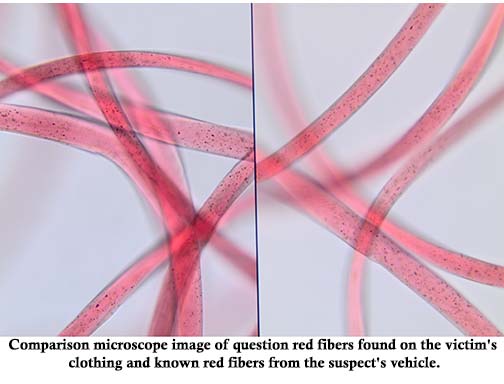
Fiber transfer can occur when contact takes place between individuals or objects. For example, clothing fibers from a pedestrian may transfer to an automobile that strikes them. Those fibers can then be compared to the pedestrian's clothing to provide evidence that the automobile struck the pedestrian. Fiber comparisons also arise in homicides, assaults, and sexual assaults. Transfers are compared against a known fiber standard to establish an association between two or more people, or between a person and a crime scene or object.
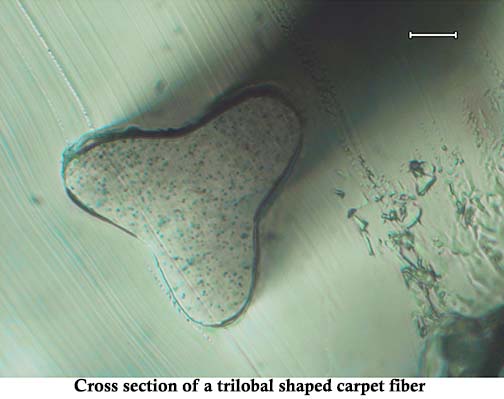
There are many different types of fiber. Fibers can be classified as natural, such as cotton, wool, and silk, or synthetic, such as nylon, acrylic, and polyester. The color, shape, and chemical composition of a fiber are used to compare an unknown sample against a known source.
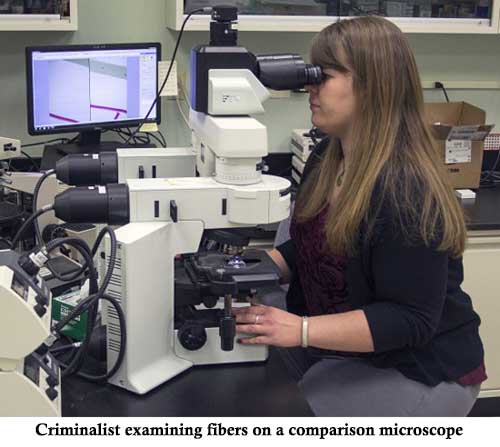
Fiber examinations are performed using polarized light microscopy, color analysis by microspectrophotometry (MSP), and Fourier transform infrared spectrometry (FTIR).
Content updated 11 August 2020.
Filaments
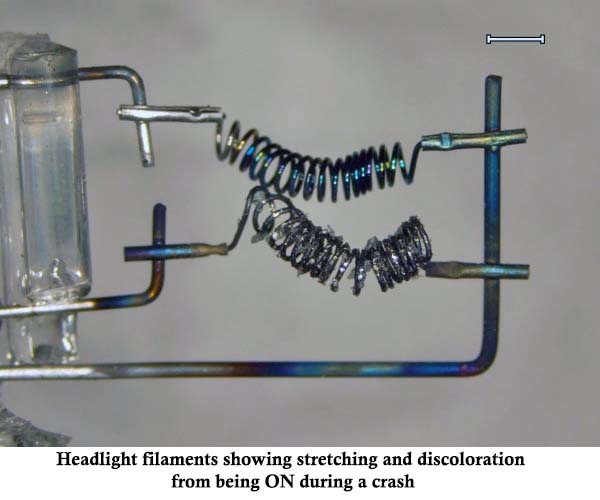
Tungsten filament vehicle lamps are examined to determine whether a lamp was on or off at the time of a crash. That determination can assist in crash reconstruction and in establishing fault.
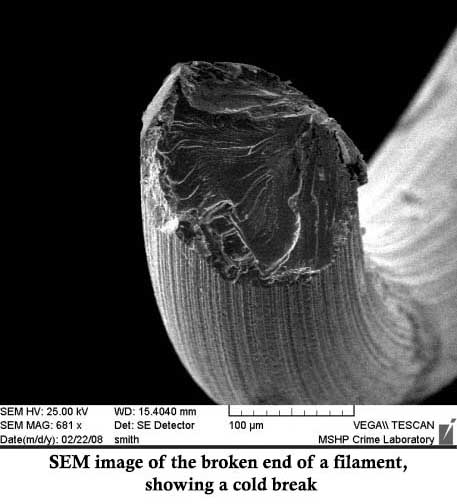
The finding is generally based on how the impact affects the configuration or condition of the filament inside the lamp. Filaments that were on may show stretching or discoloration. Filaments that were off may show cold breakage or natural burnout.
Filament examinations cannot be performed on LED or HID lamps.
Examinations include continuity testing and microscopy.
Content updated 11 August 2020.
Fire Debris
Fire debris examinations arise from suspicious fires in buildings, homes, vehicles, and elsewhere. Gasoline and other ignitable liquids used to start fires leave detectable residues after the fire has burned down or been extinguished. Detecting those residues in debris collected at the scene can be used to classify the type of ignitable liquid used, such as gasoline or mineral spirits. This analysis cannot identify an ignitable liquid to a particular brand.
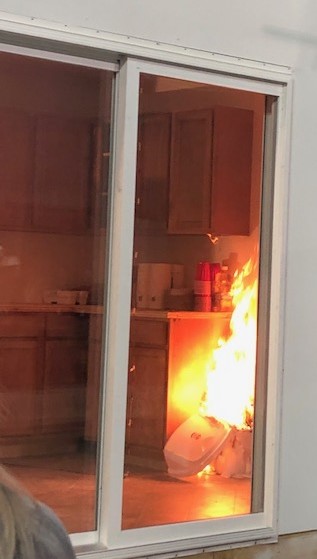
Evidence submitted for fire debris analysis must be in a vapor-tight container, such as a metal paint can or a fire debris bag. Submitted debris is analyzed for ignitable liquids using activated charcoal and a gas chromatograph/mass spectrometer (GC/MS).
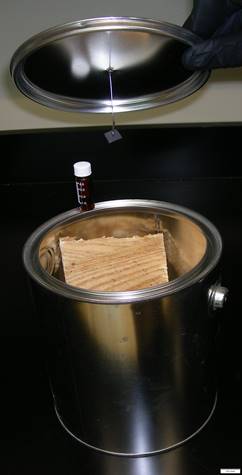
Metal paint can with fire debris, an activated charcoal strip suspended from the lid, and an amber vial for archiving the remainder of the strip for possible future analysis.
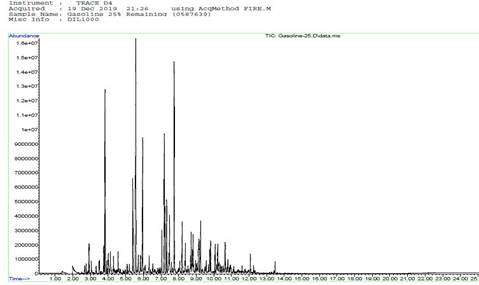
Total ion chromatogram of gasoline.

Total ion chromatogram of Kingsford charcoal lighter, a medium petroleum distillate.
Fracture Match
Matching broken or torn objects can be similar to putting together the pieces of a jigsaw puzzle. The edges and surface markings are used to align the items in question, demonstrating that two or more pieces were at one time a complete unit.
Evidence in these cases has included broken knives, damaged car parts, torn duct tape, torn clothing, broken glass, and broken wood trim.
Fracture match examinations are performed using microscopy.
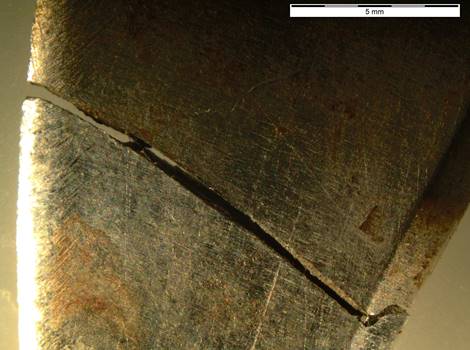
Fracture match of a broken knife blade tip to the rest of the blade.
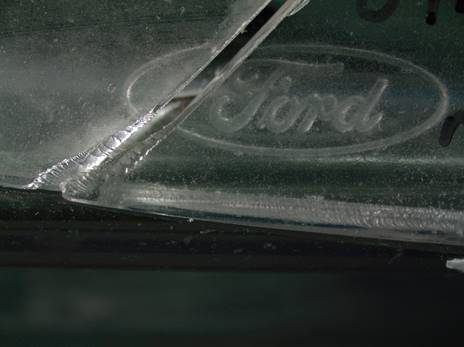
Fracture match of an automobile headlight, showing a manufacturer emblem continuing from one piece to the other.
Glass
Glass examinations typically arise from burglaries or hit and run crashes. Small glass particles, not readily visible to the naked eye, can be located on clothing or shoes and analyzed. Questioned glass samples are compared against a known glass standard, such as doors and windows, automobile windshields, mirrors, and glass containers. Glass can vary in color, shape, thickness, refractive index, and trace elemental content.
Glass examinations are performed using physical measurements, microscopy, glass refractive index measurement (GRIM), and x-ray fluorescence (XRF). Microspectrophotometry may be used on colored glass samples.
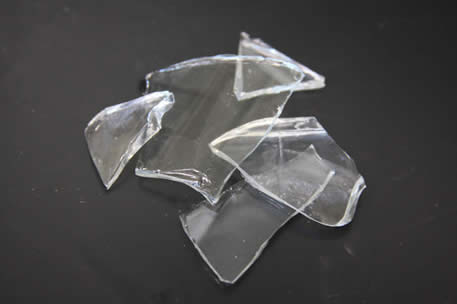
Glass evidence examined by the laboratory.
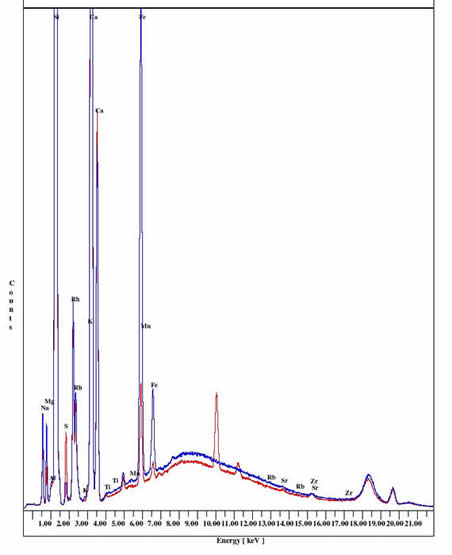
XRF spectrum of two glass samples showing different elemental content.
Gunshot Residue
Gunshot residue kits are analyzed to determine whether an individual was in the vicinity of a discharged firearm. The presence of gunshot residue on a person's hands indicates that the person discharged a firearm, was near a firearm when it was discharged, or touched an object with gunshot residue on it.
The kit contains two stubs with carbon tape adhesive, used to tape lift the palm and back surfaces of a shooting suspect's hands. Because shooting victims are already connected to the discharge of a firearm, gunshot residue kits cannot usually provide additional information to an investigation and are not routinely analyzed.
The stubs are analyzed for the constituents of gunshot residue, namely the elements lead (Pb), antimony (Sb), and barium (Ba). These three originate from the primer of most firearm cartridges. Analysis is performed on a scanning electron microscope with x-ray detector (SEM/EDS).
The Crime Laboratory can supply gunshot residue kits to Missouri law enforcement agencies free of charge.
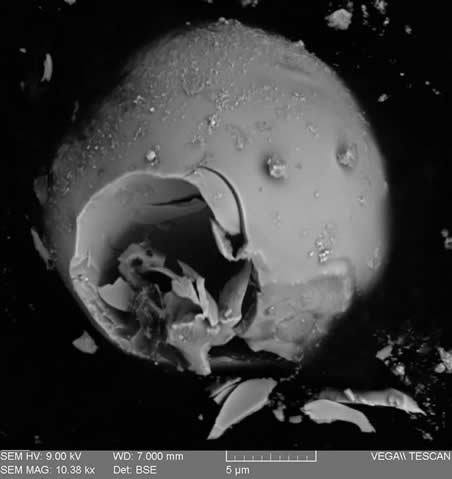
A SEM image of a gunshot residue particle.
Hair
The average person sheds about 100 hairs per day. These hairs may be of evidentiary value in showing contact between two people, or between a person and a place. Items such as clothing, bedding, or hats can be examined for the presence of hairs.
With an adequate hair standard, about 50 pulled head hairs or 25 pulled pubic hairs, a questioned hair may be microscopically compared against the standard collection to determine whether it could have come from the individual under investigation. Hairs can also be screened for eligibility for nuclear DNA analysis.
Microscopic hair comparison cannot identify a hair as coming from one individual to the exclusion of everyone else. DNA testing can strengthen any possible microscopic association. Hair examinations are performed using microscopy.
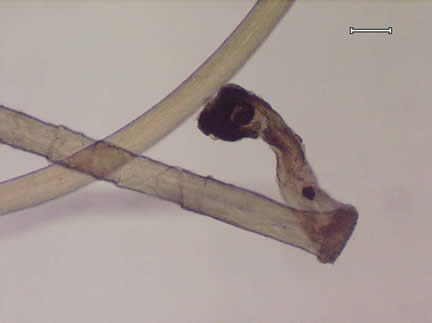
Hair with an anagen root is a good source of nuclear DNA.
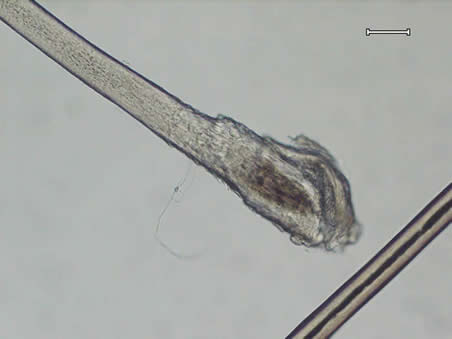
Hair with a catagen root may yield nuclear DNA.
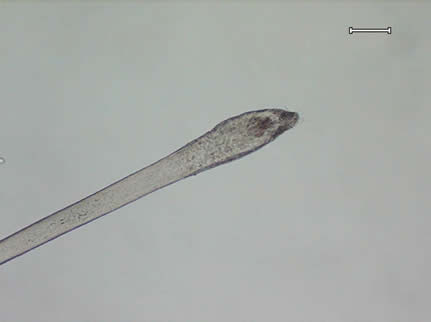
Hair with a telogen root is naturally shed and is not a good source of nuclear DNA.
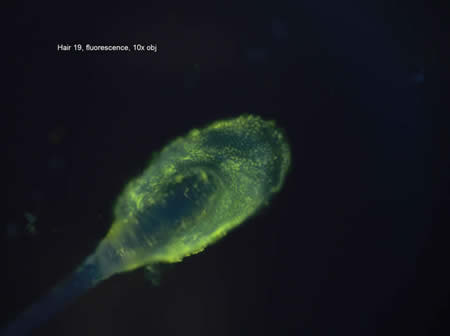
Photomicrograph of a human hair root with fluorescent dye revealing nuclei for DNA testing.
Paint
Paint examinations usually arise from hit and run cases, destruction of property, and burglary. Automotive paint can vary by manufacturer or assembly line and can change from one year to the next. Questioned paint from a tool, or a transfer on an automobile, can be compared against a known automobile paint standard to determine whether a possible common origin exists.
Paint may have many layers, so care is needed to ensure all layers down to the substrate are collected as standards for comparison. Standards should be collected near the damaged area. For automobiles, standards should be collected from all vehicles involved, as well as from suspected paint transfers.
Paint analyses may include microscopy, microspectrophotometry (MSP), Fourier transform infrared spectrometry (FTIR), and scanning electron microscopy with energy dispersive spectrometry (SEM/EDS).
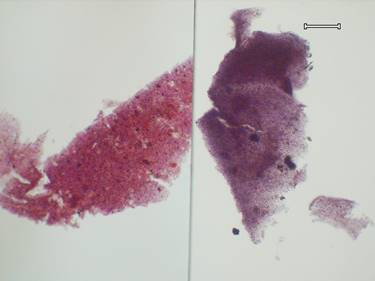
Color comparison of two red paint layers, showing they are different shades of red.
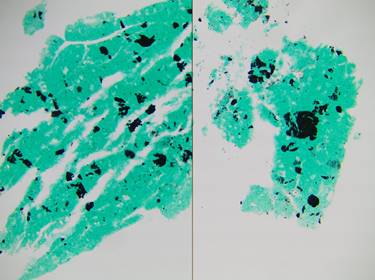
Color comparison of two similar green paint layers.
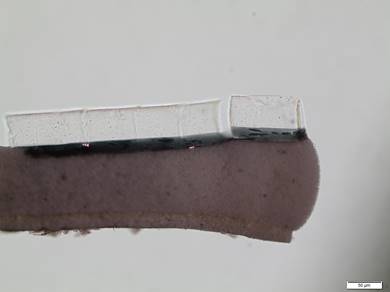
Cross sectional view of a paint chip showing four layers: a thin white, a thick white, a color layer, and a clear top coat.
Physical Characteristics
Physical characteristics comparisons can arise from a wide variety of evidence, to determine whether two items are similar. Types of evidence that may be compared in this way include woods, plastic bags, fabrics, and metal or plastic objects.
Examinations may include physical measurements, microscopy, Fourier transform infrared spectrometry (FTIR), scanning electron microscopy with energy dispersive spectrometry (SEM/EDS), Raman spectroscopy, and x-ray fluorescence (XRF).
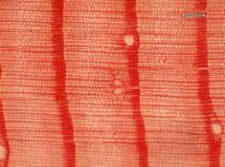
Softwood.
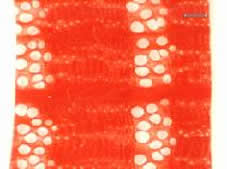
Hardwood.
Examinations of prepared wood samples can be used to classify wood as soft or hard. If enough sample is present, the wood may be classified to a genus or, ultimately, a species.
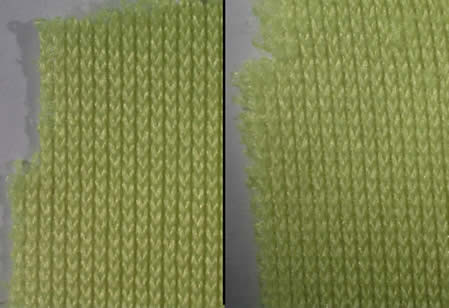
Physical characteristics comparison of knit fabric samples. If the knit pattern is similar, the fibers of the fabric can be further examined.
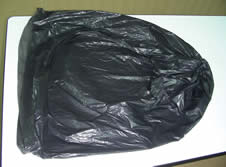
Single trash bag.
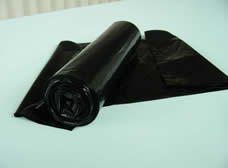
Roll of trash bags.
Physical characteristics comparison of a single black trash bag against a roll of black trash bags.
Pressure Sensitive Tape
Many types of tape may be used in the commission of a crime, including duct tape, electrical tape, packaging tape, and strapping tape. Tape may be used as a gag, ligature, restraint, or blindfold. It may also be found on improvised explosive devices or wrapped around packages of drugs.
Tapes vary by construction and composition and can provide good class evidence. Tape found at a crime scene or on a victim can be compared against known rolls of tape in the possession of individuals under investigation.
Tape examinations may include physical measurements, microscopy, Fourier transform infrared spectrometry (FTIR), scanning electron microscopy with energy dispersive spectrometry (SEM/EDS), and gas chromatography/mass spectrometry (GC/MS).
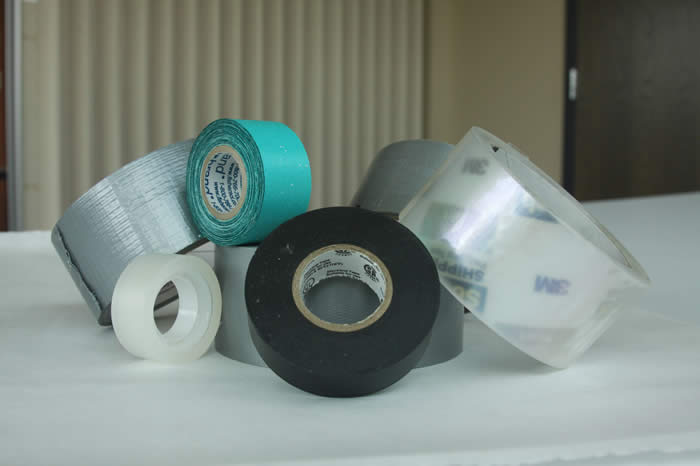
Rolls of tape of the kind submitted for comparison.
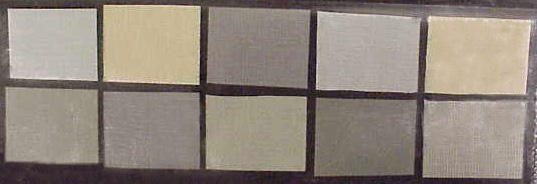
Variation of adhesive colors across duct tape samples.
Soil
Soil comparisons can establish whether soil from a crime scene is similar to soil found on items associated with a suspect, such as shoes, clothing, tools, or tires. Soil standards from the crime scene must also be collected for comparison.
Many soils can be differentiated by color, but they are primarily assessed by comparing mineral content. Soils from random sources are typically different, so soil from a suspect's shoes that is similar to soil from a specific location may help place that person there.
Soil examinations are performed using color comparison, sieving the soil into size fractions, and microscopy.
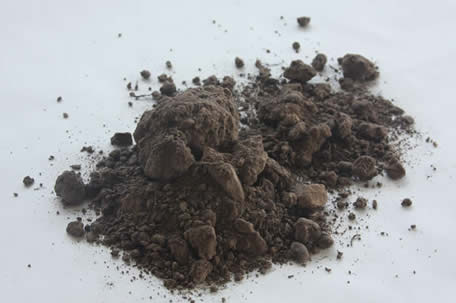
A sample of soil submitted for comparison.
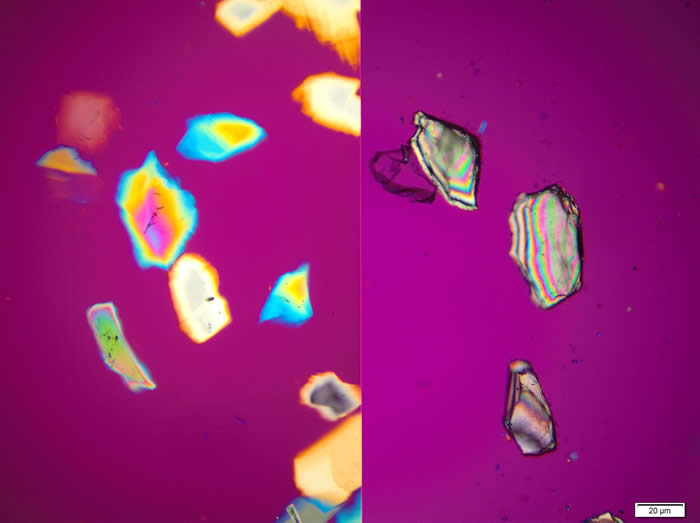
Comparison polarized light microscope image of two different minerals from soil.
Substance Identification
If an unidentified substance is found during an investigation, the laboratory can attempt to identify the substance, or components within it, to assist the investigator. Where a source is suspected, a control sample should be submitted for comparison.
Substances identified in the laboratory have included ethylene glycol (antifreeze), acids, pesticides, potassium cyanide, building materials, food products, and household products.
Examinations may include physical measurements, chemical spot testing, microscopy, Fourier transform infrared spectrometry (FTIR), scanning electron microscopy with energy dispersive spectrometry (SEM/EDS), Raman spectroscopy, x-ray fluorescence (XRF), and gas chromatography/mass spectrometry (GC/MS).

Sugar (sucrose) and starches viewed under a polarized light microscope.
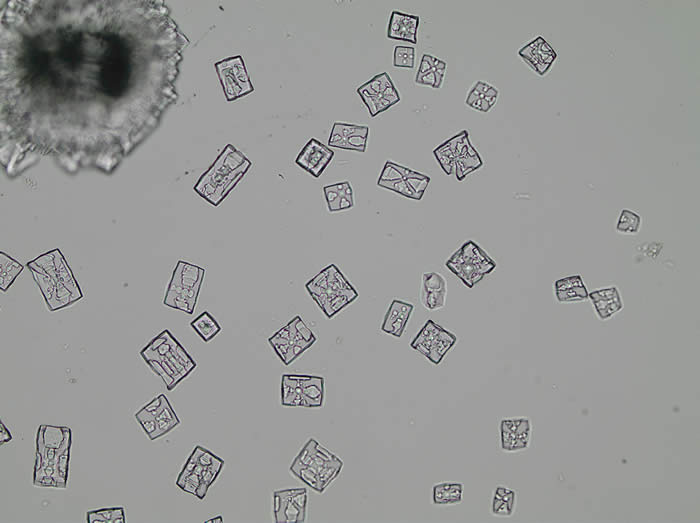
Photomicrograph of potassium cyanide recrystallized from a water and glycerin mixture.
Get in touch
Contact the Crime Laboratory
Office hours are 8:00 AM to 4:30 PM, Monday through Friday.