
Relocation notice
The Crime Laboratory is moving to 135 N. Chestnut Street
The Missouri State Highway Patrol Crime Laboratory, currently located at 1510 East Elm Street, Jefferson City, Missouri, will be relocating to a new facility at 135 N. Chestnut Street, Jefferson City, Missouri, on or about January 1, 2027. Please update your records to reflect the new Crime Laboratory address:
Missouri State Highway Patrol
Crime Laboratory
135 N. Chestnut Street
Jefferson City, MO 65101
Additional information regarding the transition, including any changes to evidence submission procedures or services, can be obtained by contacting the laboratory at (573) 526-6134.
The new building is the State of Missouri Multi-Agency Laboratory Campus, which will also house laboratories for the Departments of Health and Senior Services, Natural Resources, Agriculture, and Conservation. Read about the project (opens on oa.mo.gov).
What the Section Does
The DNA Casework section works criminal cases involving homicide, sexual assault, burglary, assault, and missing persons, among other crimes. The section is responsible for locating and identifying biological fluids and obtaining DNA profiles from crime scene evidence.
Law enforcement agencies throughout Missouri submit crime scene evidence to the laboratory. Where appropriate, DNA analysts search for and identify semen and human blood using a combination of presumptive tests, which indicate a body fluid may be present, and confirmatory tests, which establish that it is. Analysts then attempt to develop a DNA profile from the item. Although DNA is present in saliva, vaginal secretions, and skin cells, analysts cannot test for or identify these sample types.
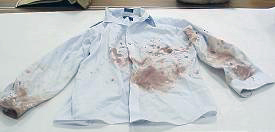
A shirt with red-brown staining, which would be further tested with presumptive blood tests.
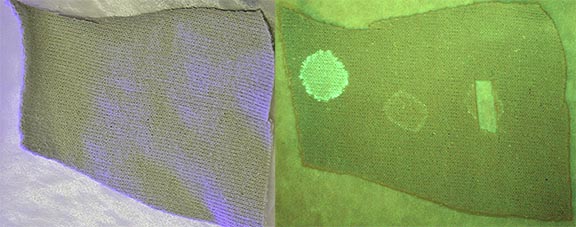
Sweatshirt fabric under normal light (left) and under an alternate light source (right). Stains become visible and are tested further with presumptive and confirmatory semen tests.
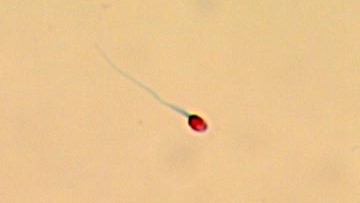
The confirmatory test for semen uses a microscope to visualize sperm cells, with the head stained red and the tail stained green.
Technology and Methods
The laboratory began using the Polymerase Chain Reaction (PCR) in 1995, and shortly afterward applied it to the analysis of short tandem repeats (STRs), beginning in 1999 and continuing today. PCR combined with STR analysis allows DNA profiles to be developed from challenging samples, including those containing low quantities of DNA and those subjected to harsh conditions such as decomposition.
The laboratory added Y-STR technology in 2005. Y-STR analysis targets the Y chromosome, found only in male individuals, and can help when small quantities of male DNA are present alongside large quantities of female DNA. This is common in sexual assault cases, particularly where sperm cells are absent or where significant time has passed between the assault and evidence collection. Because the Y chromosome is inherited unchanged through the paternal line, Y-STR testing cannot identify a specific individual: a man's father, brother, grandfather, son, paternal uncle, and paternal nephew will share the same Y-STR profile. It remains useful where traditional STR analysis has not succeeded.
How a DNA Profile Is Developed
Developing a DNA profile from an item of evidence involves four basic steps.
1. Extraction
Cells in the sample are broken open and the DNA inside is purified, typically using a robotic instrument that automates the process.
2. Quantification
The quantity of human DNA present is measured, along with whether a male contributor may be present and whether the sample may be degraded.
3. Amplification
PCR targets STR locations across most of the 23 chromosomes, including X and Y, and copies them millions of times.
4. Separation and Detection
A genetic analyzer separates and detects the amplified DNA by capillary electrophoresis, and the results are analyzed.
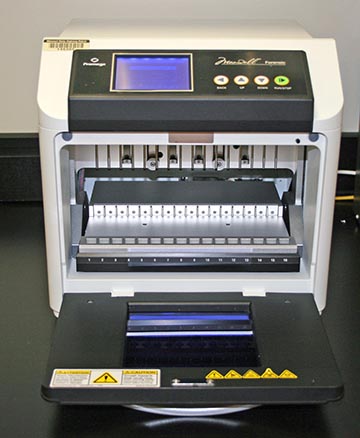
The Maxwell 16 automates the DNA extraction process for 16 samples at a time.
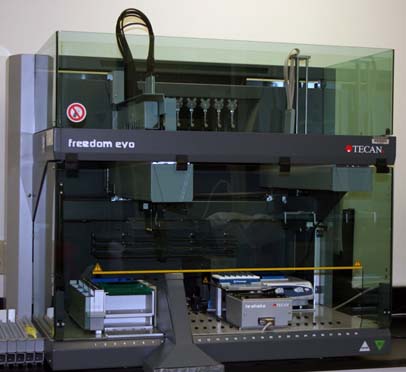
The TECAN Freedom EVO automates liquid handling, freeing the analyst from manual set-up.
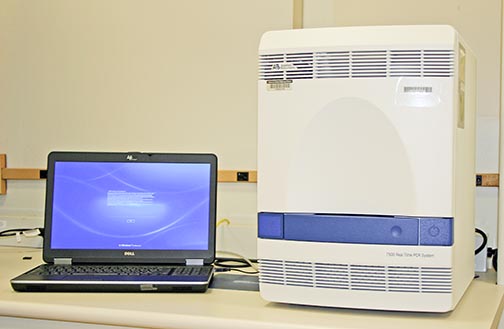
The 7500 Real-Time PCR System performs quantification, the second step in DNA analysis.
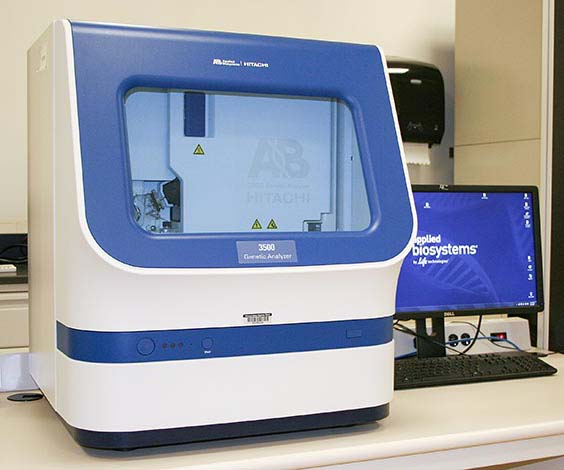
The 3500 Genetic Analyzer contains eight capillaries, allowing eight samples to be analyzed simultaneously.
The analyst then compares the profile developed from the evidence against a profile from a known reference sample, usually a cheek swab or a blood sample. An evidence profile may come from a single individual or from several. The reference profile is used to determine whether it matches a single source profile, contributes to a mixture, or is excluded. Where a sample is of poor quality or forms a complex mixture, it may not be possible to reach any conclusion about whether an individual is present.
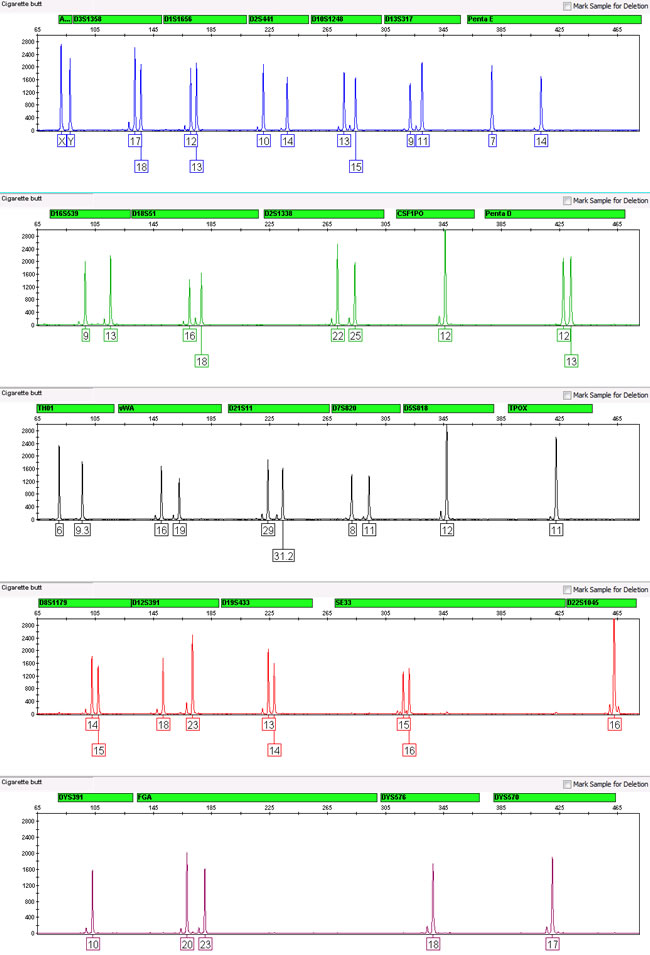
A complete male DNA profile, with information present at each genetic location tested.
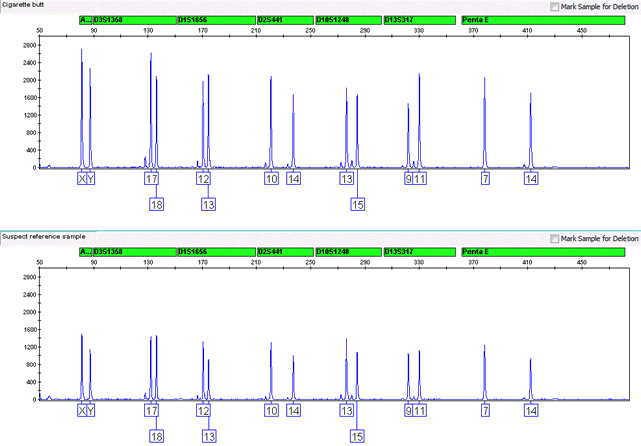
A comparison of two separate DNA profiles that match at every genetic location tested.
CODIS
The DNA Casework section also participates in the Combined DNA Index System (CODIS), made up of local, state, and national DNA databases that together hold millions of profiles, including those from convicted offenders, crime scenes, unidentified human remains, and relatives of missing persons. CODIS allows laboratories to compare profiles electronically, helping to identify previously unknown perpetrators and to connect multiple crimes to a single individual across or within jurisdictions.
Get in touch
Contact the Crime Laboratory
Office hours are 8:00 AM to 4:30 PM, Monday through Friday.